
December 10th, 2025
Short Takes

A researcher holds a sediment core from Cowpar Lake in Alberta. Photo courtesy of Ave Dersch/Chipewyan Prairie First Nation/Moccasin Flower Consulting
A 1940s landslide in eastern Alberta’s Cowpar Lake—known to the Dene people as Doghostú—transformed the lake's geochemistry and the life within it. Elders from the Chipewyan Prairie First Nation recall the event clearly: the water darkened, the fish vanished, and the lake changed. Now, sedimentary DNA (sedaDNA) preserved in the lakebed provides genetic data that complement these memories. By analyzing genetic traces from algae, parasites, and fish, researchers were able to reconstruct nearly a century of ecological change—revealing a sharp drop in eukaryotic diversity. The findings suggest the lake’s whitefish disappeared amid growing algal blooms and oxygen loss caused by the slide.
The study demonstrates how DNA preserved in sediment can capture long-term ecological memory—and how, paired with Indigenous knowledge and histories, it can reveal a fuller picture of environmental change and resilience. The study, led by University of Victoria’s Mark Louie Lopez in collaboration with Hakai Institute researchers, is a novel example of how eDNA can be used to support Indigenous knowledge of historical ecosystem changes.
Geospatial Team Partners with Gitga’at First Nation on Shoreline Monitoring

One of the many incredible petroglyphs found along the shoreline of Gitga’at First Nation territory. Photo courtesy of Keith Holmes
In June and July of 2025, the Hakai Institute joined the Gitga’at Oceans and Lands Department and partners from Vancouver Island University (VIU) to launch a new phase of coastal monitoring in Gitga’at Territory. Using LiDAR and photogrammetry drones, the team surveyed nine remote shorelines along the Douglas Channel and the inlets of the Great Bear Sea—establishing high-precision benchmark datasets to track how ship traffic and wave energy shape the coast over time.
Alongside the data collection, Hakai Institute researchers Keith Holmes and Nick Viner, together with Anthony Maue from VIU, worked with a cohort of Gitga’at Guardians on hands-on drone operations to strengthen local monitoring capacity for future surveys. Despite some challenging weather, all sites were successfully captured—producing detailed elevation models of these tidal landscapes. The project supports the Gitga’at First Nation’s ongoing efforts to assess the sensitivity of shorelines and intertidal habitats to ship wake activity.
From Fungi to Ground Sloths: Reconstructing Southern Vancouver Island Palaeoecology

Palaeocology researcher Chris Hebda samples a Nigel House site sediment block for DNA processing at the Hakai Institute Ancient DNA Laboratory, left; on the right, Hebda displays the distal humerus of an ancient, unidentified species of bison.
On southern Vancouver Island, a newly exposed archaeological site in Saanich is opening a window into the late Pleistocene. Excavation for the new Nigel House, a facility for adults with disabilities, has revealed wetland sediments and dozens of animal bones dating back 13,000 to 14,000 years. Hakai Institute researchers are collaborating with local archaeologists and First Nations to analyze bone and sediment samples at the site using ancient DNA and pollen analyses.
The finds under study include large bones from an extinct, as-yet unidentified species of bison, and remains that are suspected to belong to Jefferson's ground sloth (Megalonyx), which went extinct approximately 13,000 years ago. Some of the bison bones also appear to have cutmarks, which may indicate hunting and butchering by ancient humans.
The team hopes to reconstruct the palaeoecology of the site, identifying the plants, animals, and fungi of this dynamic landscape during as the glaciers melted and ecosystems changed at the end of the last ice age.
Analyzing the samples requires state-of-the-art palaeogenomics techniques. Whole ecosystems can be reconstructed through the recovery and analysis of billions of DNA fragments that had been left behind and buried with sediments at the site thousands of years ago.
Initial results suggest that as sea level fell rapidly from approximately 70 meters elevation above today’s shoreline, wetlands developed across low-lying areas of what is now Greater Victoria. The landscape may have been a partially open parkland with stands of pine, spruce, and aspen trees interspersed with grassy openings with wildflowers.
Forthcoming sediment DNA results from the site may reveal additional species that left no visible remains. The work will show how ecosystems re-established after the ice retreated—whether species persisted in coastal refugia, how megafauna moved through the region, and what Vancouver Island looked like at the end of the Pleistocene as early people began to spread across the coast.
Coralline Algae Study Wins Provasoli Award
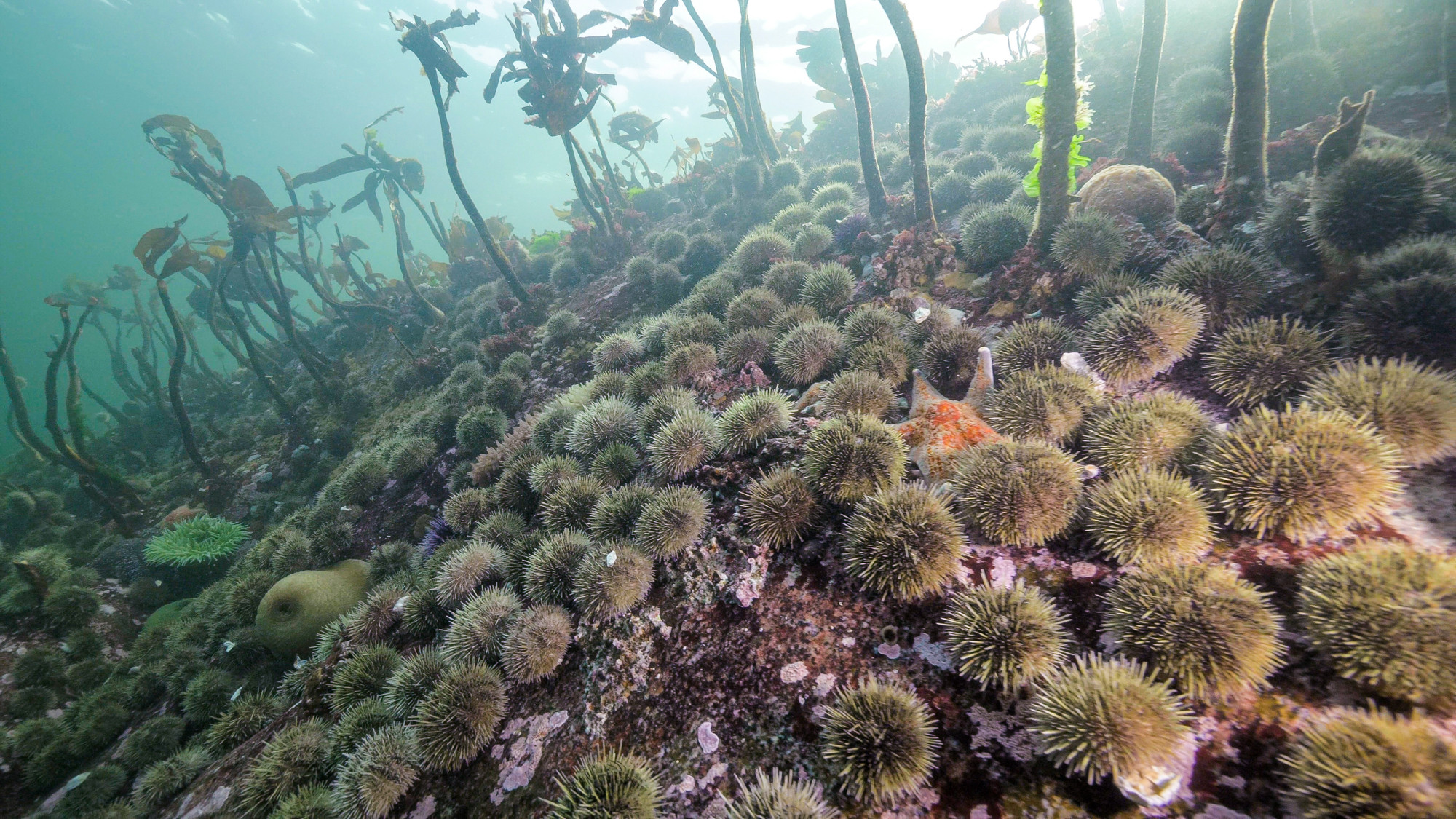
This photo of an “urchin barren” from Hakai Pass, British Columbia, shows how green urchins have stunted the growth of kelp in this spot. The pink-purple carpet encrusted on the seafloor is formed of coralline algae.
A study involving Hakai Institute researcher Matt Lemay and led by Brenton Twist from the Martone Lab at the University of British Columbia—which earned the 2024 Provasoli Award for outstanding phycological research—found that the presence of coralline algae significantly increases the rate of sea urchin metamorphosis.
Coralline algae are calcified red seaweeds common in both kelp forests and urchin barrens, and they appear to play a key role in shaping coastal ecosystems. In their study, the researchers found that urchin metamorphosis and kelp recruitment did not depend on any single species of coralline algae, implying these seaweeds all had the same effect. The findings suggest that coralline algae, often overlooked in kelp forest research, are active drivers in the structure and function of these nearshore ecosystems. Full paper (link)
New Names from the Intertidal: Honouring Peterson and Munck

Protohalopteris petersonii (left) and Petrospongium munckiae (right), are two brown algae species newly identified through 13 years of Hakai–UBC field research on Calvert Island.
After 13 years of meticulous seaweed surveys around Calvert Island, researchers have catalogued 67 species of brown algae—half of all the species known in British Columbia. The long-term study, led by Sandra Lindstrom and Patrick Martone of the University of British Columbia in collaboration with the Hakai Institute, highlights how sustained fieldwork can transform our understanding of coastal biodiversity.
Among the findings are two species new to science: Protohalopteris petersonii and Petrospongium munckiae, named in honour of Hakai Institute founders Eric Peterson and Christina Munck.
“Their long-term support for seaweed taxonomy research has had a significant impact on our understanding of coastal biodiversity,” says Hakai Institute research scientist Matt Lemay, one of the coauthors of the paper.
“Through their support for these surveys, Eric and Christina continue to be champions of the biological underdogs, always interested in the more obscure and under-appreciated aspects of coastal biodiversity.”