Back to top
Tula Quarterly Q3, 2025

December 10, 2025

Partnerships Rule

Welcome to Tula Quarterly! In this issue, we see the power of collaboration everywhere—from the waters off northern Vancouver Island to the rural villages of Guatemala to the rivers of Nunatsiavut.

  • Pacific white-sided dolphins and northern resident killer whales—two top marine predators in the northeast Pacific—have recently been recorded diving and hunting fish side by side.

  • Rivers are not just hydrological features for the Inuit people of Labrador; they are integral to well-being and cultural continuity. Inuit knowledge holders have tracked changes in ice, snow, and rivers for years, and they are helping guide the science of the Nunatsiavut Rivers Project.

  • For decades, Guatemala was riven by a deadly civil war that took a massive toll on rural Indigenous peoples. Now, through forums that give community leaders a voice in defining local health priorities, frontline healthcare workers are helping rebuild trust between rural Indigenous populations and government entities such as the Ministry of Health. 

This issue’s cover art, by illustrator Mercedes Minck, is inspired by observations of killer whales and Pacific white-sided dolphins hunting in tandem.

October 27, 2025

Braiding Knowledge: Mapping Nunatsiavut’s Changing Rivers

A new collaboration between researchers and Labrador’s Inuit is reimagining how to study the region’s watersheds.

Braiding Knowledge: Mapping Nunatsiavut’s Changing Rivers

Maurice Jacque, part of the Nunatsiavut Sea Ice Observers Program, leads a team of researchers by snowmobile along the Kaipokak River near Postville, Labrador, where they measured ice thickness during spring break-up in April 2023. Photo by Katrina Pyne/Hakai Institute

In Nunatsiavut, on the northern coast of Labrador, rivers run like veins from the land to the sea. They carry snowmelt and glacial water from the Torngat Mountains, but also the stories of Nunatsiavimmiut, the Inuit of Labrador, who travel, fish, and live along the rivers. As climate change alters their flow and the timing of freeze up, a new collaboration—the Nunatsiavut Rivers Project—is reimagining how to study these watersheds by bringing Indigenous knowledge and Western science together. 

The project works directly with community members to monitor rivers and understand how they link land, ice, and sea. It is funded through the North American Partnership for Environmental Community Action and led by Sue Ziegler of Memorial University of Newfoundland and Labrador with collaborators from Dalhousie University, Queen’s University, and the Nunatsiavut Government.  

The Hakai Institute, based in British Columbia, is playing a key role in the effort. Known for its expertise in coastal watershed mapping and classification, the institute is expanding that work across Labrador. 

Ziegler first connected with Hakai Institute researcher Ian Giesbrecht after acting as an external examiner for his PhD work, which focused on classifying watersheds on the Pacific coast. Giesbrecht’s research separated West Coast watersheds into a dozen categories—from glacierized mountains to rain lowlands—to better understand their influence on the coastal ocean and how they are responding to climate change. Ziegler saw parallels to the questions facing Inuit communities in Labrador, as well as other remote coastal communities in the region. 

The Hakai Institute’s role is focused but crucial: advising on watershed classification that is tailored to the region, providing geospatial expertise, and helping design the tools that support the team's effort to braid local priorities into large-scale mapping. 

“When you've got a really large region with a lot of geographic diversity and sparse observations on the ground, you can still do something to make some sense of the geographic variability,” says Giesbrecht, “and make some well-guided predictions about what different rivers are going to look like on the ground.”

For Nunatsiavimmiut, rivers are not just hydrological features; they are integral to well-being and cultural continuity. Through the Nunatsiavut Sea Ice Observer Program, knowledge holders have tracked changes in ice, snow, and rivers for years. Their observations now guide the Nunatsiavut Rivers Project’s science.

Braiding Knowledge: Mapping Nunatsiavut’s Changing Rivers

Researchers take depth measurements of the Kaipokak River near Postville, as part of the Nunatsiavut Rivers Project in August 2025. Left to right: Maurice Jacque, Louise Mercer, and Emma Harrison. Photo by Sue Ziegler

Known as the local weatherman in the community of Hopedale, Labrador, Reuben Flowers has been tracking daily temperature, weather, storms, and ice thickness since 1992 in half a dozen handwritten notebooks. Now part of the Nunatsiavut Sea Ice Observers Program, his long-term climate observations are the sort of invaluable local knowledge the Nunatsiavut Rivers Project leans on. 

From Hopedale, on the exposed rocky outer coast, it’s a two-hour boat or snowmobile ride inland to the nearest rivers—yet many community members still make the long trip to fish, hunt, and collect firewood and drinking water. Mirroring changing sea ice conditions, Flowers notes that the region’s frozen rivers are opening up faster and earlier than in past years, creating dangerous conditions for those venturing upriver as temperatures warm in the spring.

“You might travel over the ice one day, and the next day after a high tide and a really warm day, your tracks are panned up and you’ve got to go right along the edge closer to the shoreline,” says Flowers. 

Maurice Jacque is part of the Nunatsiavut Sea Ice Observer Program and supports the river monitoring design and implementation in the Kaipokok and English Rivers near Postville, Labrador. 

“In the winter, ice becomes our road,” he says. “As winter gets shorter it feels like our world is shrinking.”  

During the summers, Jacque supervises the English River counting fence, where they track numbers of Atlantic salmon and culturally important Arctic char that migrate upriver to spawn. He and other community members have noticed the impact warmer waters and low river levels have had on Arctic char. 

“This network of local experts in the Nunatsiavut Sea Ice Observers Program has really been the basis of developing the questions and the focus of this particular project with the rivers,” says Ziegler. “Whether it’s char or ice conditions for travel, rivers end up being really important.” 

For example, when Inuit participants raised concerns about changing river ice, researchers adjusted their methods. Hakai’s Santiago Gonzales Arriola developed new GIS approaches to quantify freeze and melt patterns—variables not considered in the institute’s earlier work on the west coast.

Braiding Knowledge: Mapping Nunatsiavut’s Changing Rivers

The Hakai Institute contributed to the creation of a map of all of the watersheds that flow into Nunatsiavut, helping researchers better understand these coastal ecosystems. As this map shows, there is even one watershed as far west as the Rocky Mountains that drains into Hudson Bay. Map by Ian Giesbrecht, Keith Holmes, and Santiago Gonzalez Arriola

The science is also becoming more interactive. Emma Harrison, a research associate with Memorial and Dalhousie universities, created an app that allows collaborators to test different watershed classifications. With a few clicks, scientists and community advisors alike can explore scenarios, compare outcomes, and help decide which models best reflect lived experience.

What began as a focus on Nunatsiavut soon grew. To understand river-coastal interactions and responses to climate change, researchers expanded their study area across the continent  to Hudson Bay, the Labrador Sea, and as far as the Rocky Mountains, in order to capture the diversity of landscape-marine ecosystem intersections. 

“Effectively, between this project and our West Coast project we’re mapping all of the watersheds, coast to coast,” says Giesbrecht.

That scale matters. Rivers link inland changes to coastal seas, influencing fisheries, sea ice, and ecosystems. As warming reshapes snow and permafrost, knowing which rivers are most vulnerable—or most crucial—becomes a tool for adaptation.

Ziegler says that this locally focused information helps small marine communities respond and adapt to climate change. “Through their desire to maintain that connection to the land, the Indigenous communities here provide a really good example for the rest of us.”

The Nunatsiavut Rivers Project is as much about process as results, and Ziegler hopes this project will be a model for other communities to learn about their own rivers and coastal ecosystems. By weaving together satellite data and local stories, researchers are building a new kind of watershed science—one rooted in both climate models and cultural priorities. For Inuit participants, the work affirms that their lived knowledge is not an afterthought, but the starting point.

December 10, 2025

Dolphins and Killer Whales Hunting Together off BC’s Coast

Scientists have documented what appears to be an unexpected alliance in the waters off northern Vancouver Island.

Dolphins and Killer Whales Hunting Together off BC’s Coast

Researchers used both aerial drones and underwater biologging tags to capture the synchronized movements of killer whales and dolphins—offering a rare above-and-below view of cooperative hunting in British Columbia’s coastal waters. Photo by Keith Holmes

Pacific white-sided dolphins and northern resident killer whales—two top marine predators in the northeast Pacific—have been recorded diving and hunting fish side by side.

New research published in Scientific Reports, led by researchers at Dalhousie University—with collaborators from the University of British Columbia, the Leibniz Institute in Germany, and the Hakai Institute—shows these interactions are not just chance encounters. Instead, these species may be engaging in cooperative foraging. 

Researchers captured coordinated aerial and underwater footage of the interactions using drones launched by Hakai Institute staff and biologging tags attached to the animals with suction cups. The recordings revealed killer whales orienting toward dolphins, following them on deep dives, and, at times, reducing their own echolocation clicks—suggesting they may have been eavesdropping on dolphin sonar to locate large Chinook salmon. Once killer whales caught their prey, dolphins were quick to scavenge the leftovers.

Dolphins and Killer Whales Hunting Together off BC’s Coast

Aerial views reveal killer whales on the hunt for salmon alongside Pacific white-sided dolphins and Dall’s porpoises in waters off Vancouver Island, British Columbia, in August 2020. Photo by Keith Holmes

Keith Holmes, a drone pilot with the Hakai Institute, first spotted the behavior.

“From above you could see this incredible amount of activity,” says Holmes. “It was clear that there was some sort of communication happening and they were actively foraging together. This was happening far too much to be just a passing oddity.”

The collaboration was discovered by chance, during fieldwork for another study. 

"As researchers, we're so focused on our particular questions that we can sometimes ignore signs that something more interesting is also occurring," says lead author Sarah Fortune.

“The prevailing thought among the killer whale research community was that, if anything, the dolphins were a bit of a pest,” adds Fortune. “If they were pests, why would the killer whales be following the dolphins?”

The findings add to a growing body of evidence showing that cooperation, long known to occur among individuals of the same species such as dolphins, can also extend across species boundaries. And in a time of dwindling salmon runs, such partnerships may help both predators adapt in a changing ocean.

November 26, 2025

Bella Coola Outdoor Ed Students Find Adventure on Calvert Island

A partnership with the Coastal Guardians and the Tula Foundation brings students to a solo camping adventure on the rugged shores of Calvert Island on British Columbia's Central Coast.

Bella Coola Outdoor Ed Students Find Adventure on Calvert Island

Students from Sir Alexander Mackenzie School (SAMS) in Bella Coola, British Columbia, gather on the Hakai Institute's Pruth Bay dock. Photo by Angie Morris

For the last 20 years, the outdoor education program at Sir Alexander Mackenzie School (SAMS) in Bella Coola, British Columbia, has been a launch pad for local youth to engage with the land and sea. The high-school program is immersive, physically demanding, and deeply rooted in place. 

“It’s a pretty full-on wilderness-based course,” says Alex Boileau, longtime outdoor ed teacher at SAMS and a passionate advocate for experiential learning. This year’s spring expedition took students in grades 10 to 12 to the Hakai Institute's Calvert Island Ecological Observatory, where water-based skills and lessons in outdoor survival, marine biology, leadership, and resilience came to life. 

Over the course of the year, students in the school’s outdoor education program build toward the spring expedition with progressive trips: an overnight fall backpacking trip, two overnight winter skills trips, and eventually a week-long experience they helped plan. This experience included a 24-hour solo that blended survival skills with solitude and self-reflection. 

The culminating challenge took place on the rugged shores of Calvert Island, where the 13 teenagers built shelters, cooked meals, and watched the ocean roll in from their solo campsites on North Beach, Seventh and Fifth beach—well above the tide levels.

Bella Coola Outdoor Ed Students Find Adventure on Calvert Island

Two SAMS students geared up for adventure on the beaches of Calvert Island. Photo by Khya Saban

Calvert Island, with its wild beaches, biodiversity, as well as ocean environment provide unique challenges, rewards and opportunities for discovery and experiential outdoor learning.

“We don’t often get conditions like this in the estuary back in Bella Coola,” Boileau explains. “Here, they can really paddle, explore in the more sheltered waters of Pruth Bay, and try ocean kayaking and surfing. They’ve seen wolves, sometimes sea otters. That connection with their surroundings is pretty special.”  

The program touches on everything from marine biology to outdoor experiential education and is assisted by Hakai Institute instructors and researchers. Some years, students in other classes, such as science or Nuxalk language courses, are added for joint field trips.

Many of them didn’t want to leave, says Boileau, noting that the lessons went far beyond the curriculum. “It was the sunshine, kayaking, surfing, the waves, hiking, and the camaraderie; they came away really being a team. Helping each other, the friendships they’ve made, the memories—that’s what stuck.”

Bella Coola Outdoor Ed Students Find Adventure on Calvert Island

The SAMS trip to Calvert Island includes surfing, kayaking, and camping, as well as educational experiences hosted by Hakai Institute researchers and staff. Photo by Angie Morris

In 2025, the students connected with Coastal Guardians—local environmental stewards who protect and manage their traditional coastal territories, some of whom are former SAMS outdoor education students. The Guardians not only support logistics but offer inspiration. 

“For students who want to go into tourism, adventure guide training, coastal guardian watchmen program, conservation—it’s a real glimpse of what’s possible,” says Boileau.

As the program prepares for 2026 with growing interest and potential for more participants, the support of school staff, parents, and partners like the Hakai Institute, SD 49, the Tula Foundation, and Coastal Guardians continues to be essential. 

“A lot of high schools say they offer outdoor education,” says Barry Squires, principal of SAMS, “but you can’t do that without ever leaving the classroom. That’s not what we do. Our kids are out there—on the land and the water to see how it actually functions, to be able to build their skills to survive there.”

December 3, 2025

Bringing Healthcare Home: Community Health Dialogues are Changing the Conversation in Guatemala

A new approach to community engagement is boosting healthcare outcomes and getting the thumbs-up from Indigenous participants.

Bringing Healthcare Home: Community Health Dialogues are Changing the Conversation in Guatemala

Claudia Violeta Ajsitz, a member of the local health commission at the El Rancho health post in San Cristóbal Verapaz, Guatemala, speaks at an interactive forum known as a Community Situation Room. Photo by Kristina Blanchflower/Tula Foundation

In the Indigenous villages of rural Guatemala, frontline nurses are the primary providers of healthcare. These nurses are often born and raised in the regions they serve and are well-versed in local language and customs—an important advantage in a country where over 22 Mayan languages, including K'iche', Q'eqchi', and Kaqchikel, are spoken. 

According to the Pan-American Health Organization (PAHO), healthcare outcomes have improved since the turn of the millennium, with maternal mortality declining 37 percent between 2000 and 2020, and infant mortality falling by over 55 percent during the same period. Since 2004, TulaSalud has trained over 2,800 frontline healthcare workers in 13 Guatemalan provinces—known as departments—and equipped many of them with a smartphone-based digital health app called Kawok. 

The program has likely played a role in the country’s improved health outcomes. But a continuing challenge, says TulaSalud president Christy Gombay, has been engaging and consulting with local communities to secure buy-in and cooperation for health initiatives—whether disease vaccinations or efforts to battle malnutrition and child and maternal mortality. 

Bringing Healthcare Home: Community Health Dialogues are Changing the Conversation in Guatemala

Delivering quality frontline healthcare to rural villages in Guatemala is challenging due to their remote locations and lack of infrastructure. Photo by Kristina Blanchflower/Tula Foundation

“Healthcare delivery in Guatemala has historically been vertical and centralized,” says Gombay. “Communities are asked for information and then told what is best for them. But different departments have different burdens of disease, different problems that they're trying to face. That becomes even more fragmented as you get down to the local, village level.” 

To begin to address this, Gombay notes that for the past three years TulaSalud has been using community surveillance data from the Kawok app and presenting it to rural villagers in forums known locally as “Community Situation Rooms.” In these forums, the data gathered by nurses on mortality, disease, and local health initiatives are presented in a simplified form and translated into the regional language. 

“The nurses’ concern is save the patient, save the patient, save the patient,” says Gombay. “What we're able to do through Kawok is return the data in an aggregated form so that nurses can come to the community leaders and say, ‘You know, compared to the last year there's been a real spike in adolescent pregnancies,’ or ‘We’re seeing way more malnourished kids at certain times of year.’”  

The point of Community Situation Rooms, says Gombay, is to give local people a chance to learn about, and then help guide and direct, health priorities.

Bringing Healthcare Home: Community Health Dialogues are Changing the Conversation in Guatemala

Ofelia Pauu, a technical assistant in the department of Alta Verapaz, speaks to participants in a Community Situation Room at Chicoj Raxquix. Photo by Rosendo Ico

“It may not sound revolutionary, giving input in this way, but it’s really trying to engage authentic, local voices,” says Gombay. “When nurses who are aware of their cultural context convey the data clearly in the native language, that leads to getting people on board. Participants in the meeting can understand and say, ‘Oh, this is why you guys are trying to do this.’”

From the 1960s to the mid-1990s Guatemala was riven with a civil war that killed over 200,000 people and displaced another 1.5 million—most of them Indigenous people living in the rural highlands. Building trust between local populations and government entities like the Ministry of Health has taken decades, says Gombay. Community Situation Rooms are part of this long-term process, and so far the results are promising. 

Ofelia Paau is a technical assistant at a health post in Chicoj, in the department of Alta Verapaz, where a Ministry of Health outpost opened in 2017. Community participation with the outpost was very limited at first, she says, but since then local leaders have formed a health commission with a community member as president and a local midwife as an advisor. 

“As we gained experience along the way, the community leaders started getting involved,” says Paau. “People are much more open and supportive now.”

Bringing Healthcare Home: Community Health Dialogues are Changing the Conversation in Guatemala

Ofelia Pauu consults the Kawok app developed by TulaSalud. Photo by Kristina Blanchflower/Tula Foundation

Local leaders have helped Paau and her colleagues reach out to pregnant women who weren’t coming for check-ups, coordinate garbage collection efforts, and gather children for weight and height monitoring.

“Now, thanks to the support from Tula, we have the Situation Room, which is very practical because it includes many images that are easy for people to understand when they come to participate,” says Paau. “We concentrate more on explaining the visuals within the situation room. The information is also much easier now—we can just download it through the Kawok telephone.”

Mayra Chocooj is the president of the local health commission in Chicoj and a frequent participant in Community Situation Room gatherings with Ministry of Health frontline healthcare workers. Chocooj points out that progress has been made focusing on  inclusiveness and equity in these processes. 

“What I feel and value is that now women are given space to participate in these matters of health,” she says. “In the past, women didn’t have those opportunities. But now that we do, we are able to support other women this way.”

Bringing Healthcare Home: Community Health Dialogues are Changing the Conversation in Guatemala

Maya Choocoj, right, poses with local community members. Chocooj is the president of the health commission of Chichoj in the department of Alta Verapaz. Photo by Kristina Blanchflower/Tula Foundation

She credits TulaSalud with the benefits of connecting the community with Ministry of Health personnel. 

“Now we know how many boys and girls are growing well and which ones are not. That’s one of our achievements—we’ve learned to identify those cases,” Chocooj says. 

Chocooj also notes that the community events help children overcome their fear of vaccines and give healthcare workers a chance to assess whether children are thriving. “We also analyze the overall health situation—what we’ve achieved and what we still need to work on in the community,”  she says.

PAHO was impressed enough with the early results of Community Situation Rooms that it co-financed scaling the programup to 477 different communities across three Guatemalan departments. 

Looking ahead in her own community, Chocooj says she would like to see more robust health service with permanent staff—and greater outreach to teen boys and girls about birth control and pregnancy. 

“We want our youth to receive that knowledge in time,” she says. “Thanks to the Community Situation Room meetings, we now have access to that information.”

November 19, 2025

An Underwater Classroom for Indigenous Guardians

Scientific diving workshops are opening up new vistas for stewardship along British Columbia’s coast.

An Underwater Classroom for Indigenous Guardians

Reef Check instructor Morgan Murphy-Cannella (left) and Sierra Hall of Kitasoo Xai’xais Nation (right) review a dive checklist during a scientific diving workshop held on Calvert Island. Photo by Margot Hessing-Lewis

Scuba divers in training often experience a kind of tunnel vision. The hiss of each breath, the squeeze of a drysuit, the tug of cold Pacific water—all of it narrows their focus to survival. Divers keep their eyes fixed on gauges and gear, barely noticing the world around them. With time, the tunnel widens. Shapes sharpen into rockfish, abalone, or kelp fronds swaying in the current. They become more aware of fellow divers. Slowly, the underwater world opens.

In early September, eight stewardship divers—including Coastal Guardians and stewardship staff from six First Nations—experienced firsthand this undersea widening of view. They had gathered at the Hakai Institute on Calvert Island for a five-day scientific diving workshop designed to build their confidence in underwater research protocols.

The workshop aimed to build scientific diving skills and develop a new kelp monitoring protocol for use by the dive teams that currently support a range of activities across British Columbia’s coastline, from archaeological exploration to clam, seagrass, and kelp surveys. 

The training was funded by WWF-Canada, the Pacific Salmon Foundation, Fisheries and Oceans Canada, and Environment and Climate Change Canada. The participants, selected by their nations, have all recently received commercial or scientific dive certifications. 

Led by instructors from the Kelp Rescue Initiative, the Hakai Institute, Reef Check, and Thalassia Environmental, the week was about refining scientific skills: learning to lay transects, identify marine species, and collecting standardized data that can be compared across regions.

An Underwater Classroom for Indigenous Guardians

Healthy kelp forests, like this one near Calvert Island, are multilayered environments, with fish and invertebrates living alongside canopy and understory kelps. Photo by Grant Callegari

For Markus Thompson, an instructor with Thalassia Environmental, the workshop was the natural evolution of years spent surveying kelp and seagrass beds with Coastal Guardian crews using kayaks and drones. He says that from above the water, it was hard to tell why some kelp beds were doing better than others. 

“We were missing more than half the picture,” says Thompson.

The first dives were like learning a dance with a new partner. Divers crowded close, shoulders bumping, as they tried to lay transect lines and count kelp stems while maintaining buoyancy. At first, divers were unsure about their ID skills, but their confidence grew each day.

“I have never actually dove in a giant kelp forest or even a bull kelp area, so it was super cool to experience that for the first time,” says Mariyah Dunn-Jones from the Pacheedaht First Nation. Participants were given a daunting list of 12 understory kelps and 30 invertebrates to learn to ID over the course of the training. “By the end of it. I felt quite confident about that list of organisms,“ she says.

Standardized methods—like counting kelp stipes along a 30-meter transect or identifying urchins, abalone, and sunflower stars for population surveys—will allow First Nations to compare results across British Columbia coastlines. That consistency could prove critical for managing ecosystems under pressure from climate change, shifting predator populations, and increased industrial activity.

The Haida Nation is considering reopening a traditional abalone harvest. For Aiden Moraes with the Haida Fisheries team, the ability to identify marine species accurately has immediate practical applications.

“It's really good to be able to tell people what's down there, and to just be mindful of how much you harvest," he says.

At home in Haida Gwaii, Moraes often dives in “urchin barrens”—areas devoid of kelp and kelp forest creatures where urchins have taken over. Calvert’s abundance stunned him. "The biodiversity here is crazy," he says. "It's overwhelming in a good way. This is what we could have at home if we just monitor and take care of areas."

An Underwater Classroom for Indigenous Guardians

(From left) Mariyah Dunn-Jones of Pacheedaht First Nation; Jasmin Schuster, manager of the Kelp Rescue Initiative; Jacob Jones of Pacheedaht First Nation; and Carter Burtlake, marine monitoring coordinator for the Huu-ay-aht First Nations. Photo by Jasmin Schuster

For Carter Burtlake, who works for the Huu-ay-aht First Nations, the workshop was an extension of his work as a marine stewardship coordinator and youth leader. “Sharing my love of the ocean with others is something that’s near and dear to my heart,” he says.

The training was structured as much around community as data collection. Guardians shared meals, swapped stories of their territories, and imagined future collaborations.

“Thinking about coming together with a group that knows those lands and waterways so well to collect that baseline data and understand how our coast is changing—that can be really powerful,” says Burtlake. 

“There were comments from some of the trainers asking if the Indigenous divers had known each other before, because they looked like they’d been friends for years,” Thompson says. “They’d only known each other for a few days.”

As the week wound down, the divers took the lead on a final kelp survey. Confidence showed in the way they moved—buoyancy under control, data sheets filled, species identified with ease. For the new network of Indigenous divers, the tunnel vision of early dives had given way to something broader: a clearer picture of ecosystems, a stronger sense of one another, and a vision for future stewardship across territories.

December 5, 2025

Charting a Climate-Ready Future for BC Seafood

A coalition of concerned researchers, community leaders, and industry representatives are coming together in 2026 for a forum focused on adaptation and responses to ocean acidification.

Charting a Climate-Ready Future for BC Seafood

Guardians from the Semiahmoo First Nation and the Salish Sea Indigenous Guardians Association map the eelgrass beds in Semiahmoo Bay, British Columbia. The assessment project is gathering baseline knowledge critical to improving the bay’s health and resilience.

Acidifying waters and declining oxygen levels are reshaping the northeast Pacific’s marine ecosystems and threatening the coastal economies that depend on them—from shellfish hatcheries to wild fisheries. Between now and 2050, losses to the BC aquaculture industry due to ocean acidification and hypoxia are projected to reach hundreds of millions of dollars. 

In response, the provincial government released the BC Ocean Acidification and Hypoxia Action Plan (BC OAH) in 2023—a comprehensive roadmap with five goals, 15 objectives, and 62 actions to mitigate and adapt to the growing threats of ocean acidification and hypoxia (OAH). 

To put the plan into motion, the province created the Climate Ready BC Seafood (CRBS) program, supported by CAN $1.7-million in funding. CRBS supports 11 collaborative projects—led by scientists, First Nations, community organizations, and industry—to identify ways to safeguard BC's coastal resources.

Charting a Climate-Ready Future for BC Seafood

A technician monitors algae-culture bioreactors inside Nova Harvest’s shellfish hatchery in Bamfield, British Columbia. These controlled systems produce the live microalgae essential for feeding developing oyster and clam larvae.

Together, these projects have tested new ways to monitor, mitigate, and adapt to ocean acidification and hypoxia. Researchers at Vancouver Island University are identifying genomic markers linked to oyster resilience, while members of the Salish Sea Indigenous Guardians Association are tracking eelgrass health and fish communities. 

Tourism operators, such as the Wilderness Tourism Association, are deploying ocean sensors on small vessels to monitor changing conditions, and hatcheries like Nova Harvest are using real-time carbonate data to adapt their operations. 

Each effort tackles a piece of the same puzzle: how to sustain healthy oceans and a thriving seafood sector as OAH shifts ocean conditions.

Charting a Climate-Ready Future for BC Seafood

A researcher examines a juvenile crab in a mesocosm experiment at the University of British Columbia, working to pinpoint the ocean-acidification tipping points that put Dungeness crabs and other shellfish at risk.

The BC OAH Action Plan has been recognized internationally—endorsed as a UN Ocean Decade Project and highlighted by the OA Alliance as a leading case study in regional action. It’s part of a growing global movement that uses local knowledge and adaptation to drive climate action and policy development.

In March 2026, as the CRBS projects conclude, partners will gather in Nanaimo for the BC OAH Action Forum, hosted by the Tula Foundation. The forum will bring together policymakers, community representatives, researchers, and champions of ocean and climate resilience to highlight achievements, assess remaining gaps, and chart next steps for sustaining progress on OAH action once the initial funding cycle ends. 

The forum is an opportunity to carry the momentum of the CRBS program forward and keep B.C.’s seafood sector climate-ready for the long haul. It’s a reminder that even amid an overwhelming global challenge, collaboration can drive tangible adaptation.

Charting a Climate-Ready Future for BC Seafood

Jack Harth, left, Oregon State University (OSU) professor and executive director of the Marine Studies Initiative, prepares an oceanographic glider for deployment with a technician in an OSU lab. OSU works with the Wilderness Tourism Association to deploy gliders that measure depth, temperature salinity, oxygen, and pH. Photo courtesy Kimberly Kenny/Oregon State University

December 10, 2025

Short Takes

Revisiting a Lake Landslide in Dene Territory

Short Takes

A researcher holds a sediment core from Cowpar Lake in Alberta. Photo courtesy of Ave Dersch/Chipewyan Prairie First Nation/Moccasin Flower Consulting

A 1940s landslide in eastern Alberta’s Cowpar Lake—known to the Dene people as Doghostú—transformed the lake's geochemistry and the life within it. Elders from the Chipewyan Prairie First Nation recall the event clearly: the water darkened, the fish vanished, and the lake changed. Now, sedimentary DNA (sedaDNA) preserved in the lakebed provides genetic data that complement these memories. By analyzing genetic traces from algae, parasites, and fish, researchers were able to reconstruct nearly a century of ecological change—revealing a sharp drop in eukaryotic diversity. The findings suggest the lake’s whitefish disappeared amid growing algal blooms and oxygen loss caused by the slide.

The study demonstrates how DNA preserved in sediment can capture long-term ecological memory—and how, paired with Indigenous knowledge and histories, it can reveal a fuller picture of environmental change and resilience. The study, led by University of Victoria’s Mark Louie Lopez in collaboration with Hakai Institute researchers, is a novel example of how eDNA can be used to support Indigenous knowledge of historical ecosystem changes.

Geospatial Team Partners with Gitga’at First Nation on Shoreline Monitoring

Short Takes

One of the many incredible petroglyphs found along the shoreline of Gitga’at First Nation territory. Photo courtesy of Keith Holmes

In June and July of 2025, the Hakai Institute joined the Gitga’at Oceans and Lands Department and partners from Vancouver Island University (VIU) to launch a new phase of coastal monitoring in Gitga’at Territory. Using LiDAR and photogrammetry drones, the team surveyed nine remote shorelines along the Douglas Channel and the inlets of the Great Bear Sea—establishing high-precision benchmark datasets to track how ship traffic and wave energy shape the coast over time.

Alongside the data collection, Hakai Institute researchers Keith Holmes and Nick Viner, together with Anthony Maue from VIU, worked with a cohort of Gitga’at Guardians on hands-on drone operations to strengthen local monitoring capacity for future surveys. Despite some challenging weather, all sites were successfully captured—producing detailed elevation models of these tidal landscapes. The project supports the Gitga’at First Nation’s ongoing efforts to assess the sensitivity of shorelines and intertidal habitats to ship wake activity.

From Fungi to Ground Sloths: Reconstructing Southern Vancouver Island Palaeoecology

Short Takes

Palaeocology researcher Chris Hebda samples a Nigel House site sediment block for DNA processing at the Hakai Institute Ancient DNA Laboratory, left; on the right, Hebda displays the distal humerus of an ancient, unidentified species of bison.

On southern Vancouver Island, a newly exposed archaeological site in Saanich is opening a window into the late Pleistocene. Excavation for the new Nigel House, a facility for adults with disabilities, has revealed wetland sediments and dozens of animal bones dating back 13,000 to 14,000 years. Hakai Institute researchers are collaborating with local archaeologists and First Nations to analyze bone and sediment samples at the site using ancient DNA and pollen analyses. 

The finds under study include large bones from an extinct, as-yet unidentified species of bison, and remains that are suspected to belong to Jefferson's ground sloth (Megalonyx), which went extinct approximately 13,000 years ago. Some of the bison bones also appear to have cutmarks, which may indicate hunting and butchering by ancient humans. 

The team hopes to reconstruct the palaeoecology of the site, identifying the plants, animals, and fungi of this dynamic landscape during as the glaciers melted and ecosystems changed at the end of the last ice age.

Analyzing the samples requires state-of-the-art palaeogenomics techniques. Whole ecosystems can be reconstructed through the recovery and analysis of billions of DNA fragments that had been left behind and buried with sediments at the site thousands of years ago.

Initial results suggest that as sea level fell rapidly from approximately 70 meters elevation above today’s shoreline, wetlands developed across low-lying areas of what is now Greater Victoria. The landscape may have been a partially open parkland with stands of pine, spruce, and aspen trees interspersed with grassy openings with wildflowers. 

Forthcoming sediment DNA results from the site may reveal additional species that left no visible remains. The work will show how ecosystems re-established after the ice retreated—whether species persisted in coastal refugia, how megafauna moved through the region, and what Vancouver Island looked like at the end of the Pleistocene as early people began to spread across the coast.

Coralline Algae Study Wins Provasoli Award

Short Takes

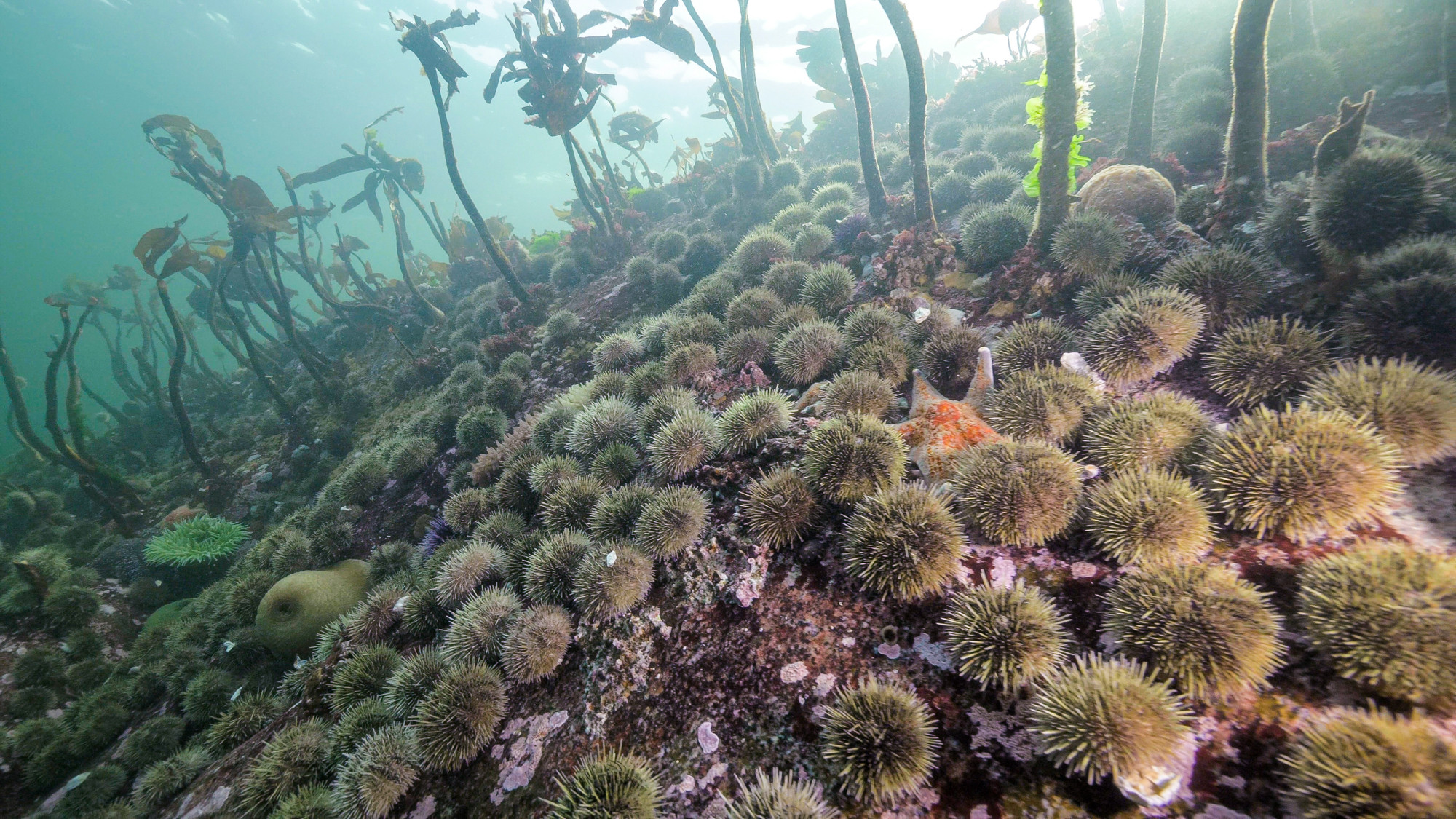
This photo of an “urchin barren” from Hakai Pass, British Columbia, shows how green urchins have stunted the growth of kelp in this spot. The pink-purple carpet encrusted on the seafloor is formed of coralline algae.

A study involving Hakai Institute researcher Matt Lemay and led by Brenton Twist from the Martone Lab at the University of British Columbia—which earned the 2024 Provasoli Award for outstanding phycological research—found that the presence of coralline algae significantly increases the rate of sea urchin metamorphosis.

Coralline algae are calcified red seaweeds common in both kelp forests and urchin barrens, and they appear to play a key role in shaping coastal ecosystems. In their study, the researchers found that urchin metamorphosis and kelp recruitment did not depend on any single species of coralline algae, implying these seaweeds all had the same effect. The findings suggest that coralline algae, often overlooked in kelp forest research, are active drivers in the structure and function of these nearshore ecosystems. Full paper (link)

New Names from the Intertidal: Honouring Peterson and Munck

Short Takes

Protohalopteris petersonii (left) and Petrospongium munckiae (right), are two brown algae species newly identified through 13 years of Hakai–UBC field research on Calvert Island.

After 13 years of meticulous seaweed surveys around Calvert Island, researchers have catalogued 67 species of brown algae—half of all the species known in British Columbia. The long-term study, led by Sandra Lindstrom and Patrick Martone of the University of British Columbia in collaboration with the Hakai Institute, highlights how sustained fieldwork can transform our understanding of coastal biodiversity.

Among the findings are two species new to science: Protohalopteris petersonii and Petrospongium munckiae, named in honour of Hakai Institute founders Eric Peterson and Christina Munck. 

“Their long-term support for seaweed taxonomy research has had a significant impact on our understanding of coastal biodiversity,” says Hakai Institute research scientist Matt Lemay, one of the coauthors of the paper.

“Through their support for these surveys, Eric and Christina continue to be champions of the biological underdogs, always interested in the more obscure and under-appreciated aspects of coastal biodiversity.”

December 10, 2025

Tula in the News

Tula in the News

A male rock greenling on the British Columbia coast gets his mugshot taken. As recent research by Hakai scientists has shown, low-oxygen waters on the continental shelf have been linked to stress, displacement, and mortality in marine species such as crabs and rockfish. Photo by Tavish Campbell

The Emerging Threat of Hypoxia on Canada’s Pacific Shelf

Several outlets covered the worrying declines in oxygen levels in Queen Charlotte Sound, a finding surfaced by a research team led by Hakai oceanographer and postdoctoral researcher Sam Stevens, along with Wiley Evans of Hakai Institute and researchers from the University of British Columbia, Fisheries and Oceans Canada, and the University of Victoria. The findings were covered by Canada’s National Observer, Business in Vancouver, the CBC, and in a CBC radio interview with Sam. 

How Marine Heat Waves Reshape Ocean Food Webs and Slow Deep Sea Carbon Transport

Phys.org reports on new findings from an international group of collaborators, including Hakai Institute microbial oceanographer Colleen Kellogg. Published in Nature Communications, the research reveals that marine heat waves can have a knock-on effect, altering planktonic communities—the base of the ocean’s food web—and subsequently, the ocean’s carbon cycle. The work highlights the need for continuous, cooperative monitoring of the ocean to better understand and predict the ecological impacts of marine heat waves.


False Creek is Alive

Colleen Kellogg joined Hakai Institute affiliate Chris Harley (UBC) on an episode of Waterbodies, a podcast from the False Creek Friends Society. The two chatted about levels of biodiversity, how climate change and other factors are impacting False Creek, and the community science bioblitz that took place there in 2022. If you prefer video, you can watch the conversation—recorded in a floating tugboat studio—over on YouTube.

Hazard Risks to Pipelines: Opinion Piece by Dan Shugar 

“Canada is a leader in oceanographic instrumentation and scientific monitoring, with organizations such as Ocean Networks Canada and the Hakai Institute as exemplars. Should a new pipeline to Kitimat or Prince Rupert be considered by the Major Projects Office, it behooves them to seriously consider the very real risk posed by landslide-triggered tsunamis,” writes Dan Shugar in The Globe and Mail. Shugar is the director of the Water, Sediment, Hazards, & Earth-surface Dynamics (waterSHED) Laboratory at the University of Calgary, where he is an associate professor.

December 10, 2025

Recent Publications

Cooperative foraging between dolphins and fish-eating killer whales

Using aerial drone and biologgers equipped with video, acoustic and inertial sensors, we recorded interactions between fish-eating northern resident killer whales (Orcinus orca) and Pacific white-sided dolphins (Lagenorhynchus obliquidens) in the presence of adult Chinook salmon (Oncorhynchus tshawytscha). We observed frequent co-occurrence and coordinated movements, with the killer whales orienting towards the dolphins and following them to depth. We also recorded reduced echolocation and rolling movements by the killer whales in the presence of dolphins, suggesting that the whales may eavesdrop on dolphin echolocations to scan broader areas to locate large Chinook salmon—prey that are too big for the dolphins to capture and swallow whole.

Fortune, S.M.E., Cheng, X., Holmes, K., Trites, A.W. (2025). Cooperative foraging between dolphins and fish-eating killer whales. Sci Rep 15, 42897. https://doi.org/10.1038/s41598-025-22718-4

Parasites of the hermit crab Pagurus hirsutiusculus; distribution, prevalence, and thermal ecology

Parasites are common throughout the biosphere and can play significant ecological roles. However, most parasites are understudied, particularly with regards to how their prevalence and impacts vary with environmental conditions. As a result, there remains an incomplete understanding of how both parasites and their hosts may be impacted by climate change. We conducted field surveys to better understand the parasite distributions of the intertidal hermit crab Pagurus hirsutiusculus in British Columbia. 

Abbott, M.H., Harley, C.D.G., Martell, H.A., Janusson, C., Lemay, M.A., Gehman, A-L.M. (2025). Parasites of the hermit crab Pagurus hirsutiusculus; distribution, prevalence, and thermal ecology. PLoS One 20(11): e0335145. https://doi.org/10.1371/journal.pone.0335145

Marine heatwaves modulate food webs and carbon transport processes

Marine heatwave (MHW) impacts on ecosystem functions and services remain poorly constrained due to limited time-resolved datasets integrating physical, chemical, and biological parameters at relevant scales. Here we show that combining over a decade of autonomous Biogeochemical (BGC)-Argo float measurements with water-column plankton community profiles reveals the impacts of MHWs on particulate organic carbon (POC) production, transformation, and transport in the northeastern subarctic Pacific Ocean.

Bif, M.B., Kellogg, C.T.E., Huang, Y., Anstett, J., Traving, S., Pẽna, M.A., Hallam, S.J., Johnson, K.S. (2025). l. Marine heatwaves modulate food webs and carbon transport processes. Nat Commun 16, 8535. https://doi.org/10.1038/s41467-025-63605-w

Late Pleistocene vegetation and climate history of northern Vancouver Island, Canada: spatiotemporal variation in deglacial ecology along the Pacific margin of the Cordilleran Ice Sheet

Palaeoecological analysis of six cores on northern Vancouver Island, Canada, reveals asynchronous vegetation responses to climatic changes at the interface of the Cordilleran Ice Sheet and the Pacific Ocean during the terminal Pleistocene and earliest Holocene. Our results demonstrate the importance of understanding regional vegetation and climatic histories at coast-continent interfaces adjacent to major components of global climate such as the North Pacific Ocean when investigating the teleconnections of oceanic and atmospheric systems.

Hebda, C.F.G., Hebda, R.J., Fedje, D., Letham, B., Dyck, A., McLaren, D., (2025). Late Pleistocene vegetation and climate history of northern Vancouver Island, Canada: spatiotemporal variation in deglacial ecology along the Pacific margin of the Cordilleran Ice Sheet. Quarterly International, 747. https://doi.org/10.1016/j.quaint.2025.109955

New and interesting seaweed records from the Hakai area of the central coast of British Columbia: Phaeophyceae

After 13 years of intensive sampling of seaweeds in the Hakai area of the central coast of British Columbia, we report on our collection of 67 of the approximately 100 brown algal species expected in the area based on known distributions. A number of species are reported for the first time in the northeast Pacific: we identified Hecatonema terminale, based on efforts to sequence several host species of red algae, an undescribed species of Acinetosporaceae previously identified erroneously as Hincksia granulosa that still requires a name, and undescribed species of Pylaiella and Ectocarpus.

Lindstrom, S.C., Lemay, M.A., Janusson, C., Starko, S., Hind, K.R., Martone, P.T. (2025). New and interesting seaweed records from the Hakai area of the central coast of British Columbia: Phaeophyceae. Botany. 103: 1–24. https://doi.org/10.1139/cjb-2025-0003

Thermal suppression of gametogenesis can explain historical collapses in larval recruitment in Strongylocentrotus purpuratus

Projections for population viability under climate change are often made using estimates of thermal lethal thresholds. These estimates vary across life history stages and can be valuable for explaining or forecasting shifts in population viability. For the urchin Strongylocentrotus purpuratus, larval supply is known to decline near the southern edge of the range during marine heatwaves despite temperatures remaining below temperatures thought to limit larval survival. We experimentally show that sublethal suppression of gametogenesis by marine heatwaves can partially explain these historical collapses in recruitment. 

Okamoto, D.K., Spindel, N.B., Munstermann, M.J., Karelitz, S., Collicutt, B., Gimenez, I., Rolheiser, K. Cronmiller, E., Foss, M., Mahara, N., Swezey, D., Ferraro, R., Rogers-Bennett, L., Schroeter, S.C., (2025). Thermal suppression of gametogenesis can explain historical collapses in larval recruitment in Strongylocentrotus purpuratus. Commun Biol 8, 1490. https://doi.org/10.1038/s42003-025-08829-8

The coupled oxygen and carbon dynamics in the subsurface waters of the Gulf and Lower St. Lawrence Estuary and implications for artificial oxygenation

The Gulf and Lower St. Lawrence Estuary have experienced major environmental change over the past century, including the development of hypoxic bottom waters and their simultaneous warming and acidification. This study provides new long-term characterizations of deepwater dissolved oxygen and dissolved inorganic carbon cycling and offers a first-order assessment of the feasibility of large-scale re-oxygenation in the Gulf and Lower St. Lawrence Estuary.

Nesbitt, W. A., Stevens, S. W., Mucci, A. O., Gerke, L., Tanhua, T., Chaillou, G., and Wallace, D. W. R. (2025). The coupled oxygen and carbon dynamics in the subsurface waters of the Gulf and Lower St. Lawrence Estuary and implications for artificial oxygenation, Ocean Science., 21, 2179–2195. https://doi.org/10.5194/os-21-2179-2025

Cool ocean temperatures offer limited protection to a heat-stressed keystone predator during atmospheric heatwaves

The increasing frequency and intensity of extreme climatic events demands a better understanding of how organisms respond to temperature shifts and how these responses shape species interactions. Temperature-related disruptions in individual behaviour and physiology can signal broader community change. This is particularly true for keystone species, whose impact on their ecosystem is disproportionately large. We tested how periodic exposure to high air temperatures affects mortality, feeding, and metabolism in juvenile Pisaster ochraceus (ochre sea star), a keystone intertidal predator, by manipulating air and seawater temperatures representing typical and heatwave conditions in Barkley Sound, British Columbia, Canada.

Walton, L.N., Watts, V.R., Schuster, J.M., Bates, A.E. (2025). Cool ocean temperatures offer limited protection to a heat-stressed keystone predator during atmospheric heatwaves, Marine Ecology Progress Series 773:77–93. https://doi.org/10.3354/meps14980